

Room 408
History Doesn't Knock, It Enters

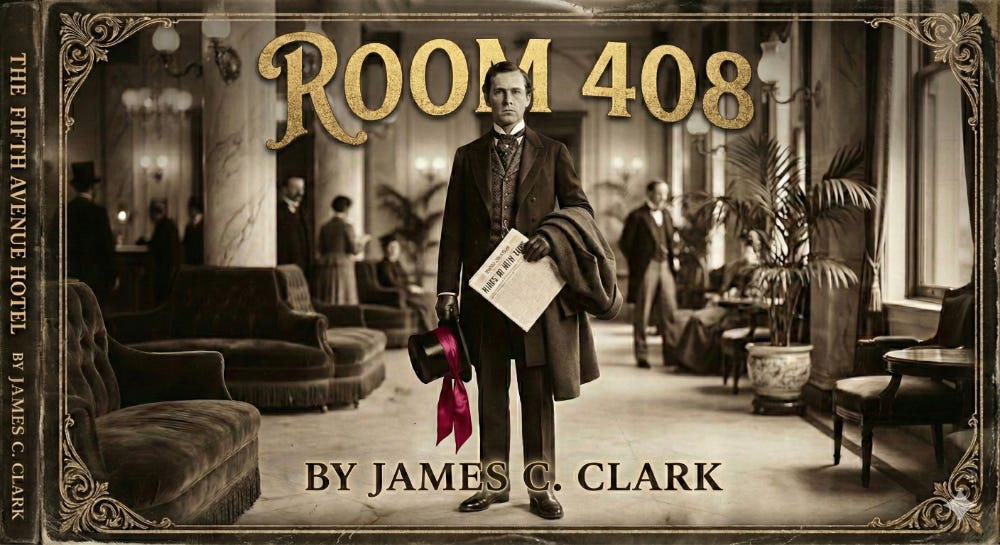
Moving across Madison Square Park, Jack Tompkins felt the July humidity sweating through him. Jack walked with the cadence of “Hancock the Superb.” Gravel crunched under his Peal & Co. boots as he headed toward The Fifth Avenue Hotel. A cloud of morbid anticipation was building. The draft riots were moving uptown and growing more violent and destructive—an unsettling sight to the New York elite shading themselves beneath the tree-lined paths.
Sweat collected on Jack’s stiffly starched shirt collar. For that very act, Sir Henry Poole himself would have disowned him. Jack crisply exited the park, past the women promenading on the Fifth Avenue side—a key location for eligible young ladies lost in discussion about day dresses, bodices, and reputation management.
Dodging hackney cabs and horse dung, Jack caught sight of the porters. They had the discipline of Ulysses’ boys. Their attention to detail was their strength, along with their earning potential. The senior porter immediately noticed Jack’s quick gait and his signature James Locke & Co. silk top hat. Jack looked right through them all. The porters knew the depth of his darkness and gladly obliged him.
“Welcome back, Mr. Tompkins,” cried a porter. The Merchant Prince of New York had arrived.
Jack didn’t respond. He didn’t need to. He had been raised to speak only when necessary. Silence had exported the nation’s cotton, tobacco, flour, and grain to a teetering world. His grandfather, Benjamin Tompkins, made his fortune on silence—and British collaboration. Benjamin had established the Tompkins name in the corridors of power as The Crown’s secret supply chain during the Revolutionary War. Cannons, howitzers, shells, muskets, gunpowder, flints, even tents—all flew under a colonial flag and the noses of the Continental Army. He was not only a war profiteer but a loyalist. Less to the British Crown, more to the British pound.
The Tompkins empire changed with the world. As the new nation grew, Jack’s father, Ethan, seized the opportunity of the exploding commodity export market. The Tompkins fortune became an empire built on cotton, tobacco, corn, and wheat. The Civil War devastated Jack’s inherited interests, and he was determined not to lose what his family had built. Jack profoundly understood the cost of war—and the lessons it had to teach.
“Mr. Tompkins,” the doormen nodded, standing erect under the gas lamps.
The entrance awning was a gathering place for those who lacked vision. You had to earn your way into The New York Club. As the doormen opened the three-hundred-pound mahogany double doors, Jack noticed the brass handles and plates shined brilliantly. Another world, Jack thought. Another time.The Fifth Avenue Hotel was the chessboard of the powerful. While pawns toiled one square at a time, their fate was being quietly calculated. Both a power game and power source, Jack thought, and I finally have this nation at check.
Jack marched across the patterned marble floor toward the main portico. He paused for five seconds to behold the grand entrance. The shimmer from the gaslight fixtures danced on gleaming white marble. Jack loved the idea of the grand entrance hall. The space alone was a statement, its high ceiling adding to the drama. Gas chandeliers hung the distance of the 165-foot spectacle. The busy and the fashionable moved through it like ants in a farm. The gentlemen were busy—not because they were important, but because they lacked Jack’s wit, his savvy, and most of all, his will. He proudly had no need for this space.
He was the grand entrance.
Jack never stopped for pleasantries or useless banter. Part calculation, part personality. He had been nurtured to believe scarcity bred demand. The less righteousness you have, the more you want it, Jack mused, passing a string trio failing to calm nervous guests. New York was burning. Jack was eager with expectation.
Michael Morris was The Fifth Avenue Hotel’s dedicated valet for Jack. Michael slowly approached, keenly aware he was late—and aware of Jack’s darkness. He held the keys to every room in the hotel, and, more importantly, the keys to the city. Officially, he worked for the hotel. In truth, he worked for the members of The New York Club. Michael was as cunning as he was patriotic. His grandfather, Lyons Morris, had crossed the Delaware in the very boat George Washington occupied. Michael was proud to serve the Union cause in his own clandestine way.
The New York Club was the inner sanctum of The Fifth Avenue Hotel—a place those in the grand hall aspired to, and those under the awning would never reach. The Club was less a location than a power source. Tucked away in chamber rooms, private parlors, and club lounges across the property, it was the power grid determining the fate of America.
Discretion was the key to Michael’s success. His guiding ethos. His methods diabolical. If an issue arose, Michael handled it before anyone became the wiser. A fixer of the first order. He was Jack’s best friend in New York, even if he didn’t know it. He didn’t have to. Michael held truths that could not be told. If Jack were to realize his purpose, Michael must be brought in.
Jack needed Michael—but Michael didn’t need to know that.
“Your pocket watch must have malfunctioned,” Jack said in his monotone voice.
“I’m terribly sorry, Mr. Tompkins. The riots have everyone in a state.”
“Well, I’m in the state of New York, but not in the Club. So, if you could be so kind…”
“Of course, Mr. Tompkins. Right this way.”
The men walked the 165-foot grand entrance, passing the New York elite plotting in hushed tones. Jack regarded them with the pity of Bill the Butcher of the Bowery. Their reactions quietly flattered him. Jack Tompkins imbued a quiet ruthlessness that was more fact than fiction. He had become the “Merchant King of New York” by waging a silent campaign against Marcellus Hartley, the scion of the New York arms dealer Schuyler, Hartley & Graham. In two years, Jack dismantled the firm and Marcellus.
By offering British arms manufacturers longer-term contracts at lower margins, Jack locked up major British factories. He moved to control the shipping lanes. He bought priority with insurers. He pre-booked reliable sailings. He offered better terms to underwriters.
Schuyler can buy the rifles, Jack thought, but they’re no use in Liverpool.
The death knell came when Jack deposited gold with British merchant banker Brown & Brothers—Schuyler, Hartley & Graham’s lender. Brown reassessed their risk. In an instant, Jack Tompkins became the largest arms dealer in the Northern states.
“Mr. Tompkins,” Michael said as they approached the grand staircase, “Mr. Potts is awaiting you in Room 204.”
Thomas Potts was the agent for the London Armoury Company—LAC, the largest arms manufacturer in Europe. While the nation fought for its identity, Jack kept the Bluecoats well-armed, fed, and in the fight. The longer the war lasted, the longer his power remained. The scales were tilting the Federals’ way. Jack was determined to maintain equilibrium.
“And 408?” Jack quietly inquired.
“Yes, sir. Room 408 has been prepared and ready for you as usual,” Michael replied. He could never make sense of Jack’s reservation.
They ascended the grand staircase, greeted by dual marble columns adorned with brass fixtures. The music from the Great Hall struck an ominous tone. Jack felt the softness of the carpet runner beneath his feet—more pleasant than the gravel of Madison Square Park or anywhere else in New York. The din of the lobby faded behind them. Jack grabbed Michael by the arm and led him into a nearby meeting room. He shut the door.
“Michael, I’ll require your services while I’m meeting with Mr. Potts.”
“Absolutely, Mr. Tompkins. What do you require?”
“I’m expecting a guest, whom I will meet in Room 408,” Jack said, lowering his voice. “I’ll need you to discreetly escort him there.”
Michael didn’t flinch. Working for The New York Club meant understanding power—and the rare few who pulled its levers.
“Name?” Michael asked as they approached Room 408.
“Arnold.”
Michael nodded as he reached for the brass doorknob. “Last name?”
“That is his last name. Arnold,” Jack said impatiently. He turned directly toward Michael before walking into the gilded sanctuary of The New York Club. His steel-gray eyes pierced through Michael’s thoughts. Michael had seen that look before—but never directed at him.
“His first name is Benedict. The third.” Jack turned swiftly through the Club’s threshold.
The doors closed.
Michael stared blankly down the second-floor portico. Only a few moments passed, but time seemed to slow. His vision narrowed. The memory of his grandfather danced in the humidity.
Michael quietly made his way toward the 23rd Street private access entrance.